Whether a store is ready for AI shopping depends on its platform
AI shopping assistants can now search a store's catalog and, in some cases, check out for the shopper. For Google's AI Mode and Gemini, the standard that makes this work is the Universal Commerce Protocol (UCP), launched in January 2026 with Shopify and other retailers and platforms. A store that supports it publishes a short profile telling an assistant what it can do: search products, build a cart, check out.
We found 22,417 websites publishing a UCP profile in October 2026. 21,138 of them are Shopify stores, and almost none of the rest wrote theirs: their platform did it for them.
The platform decides
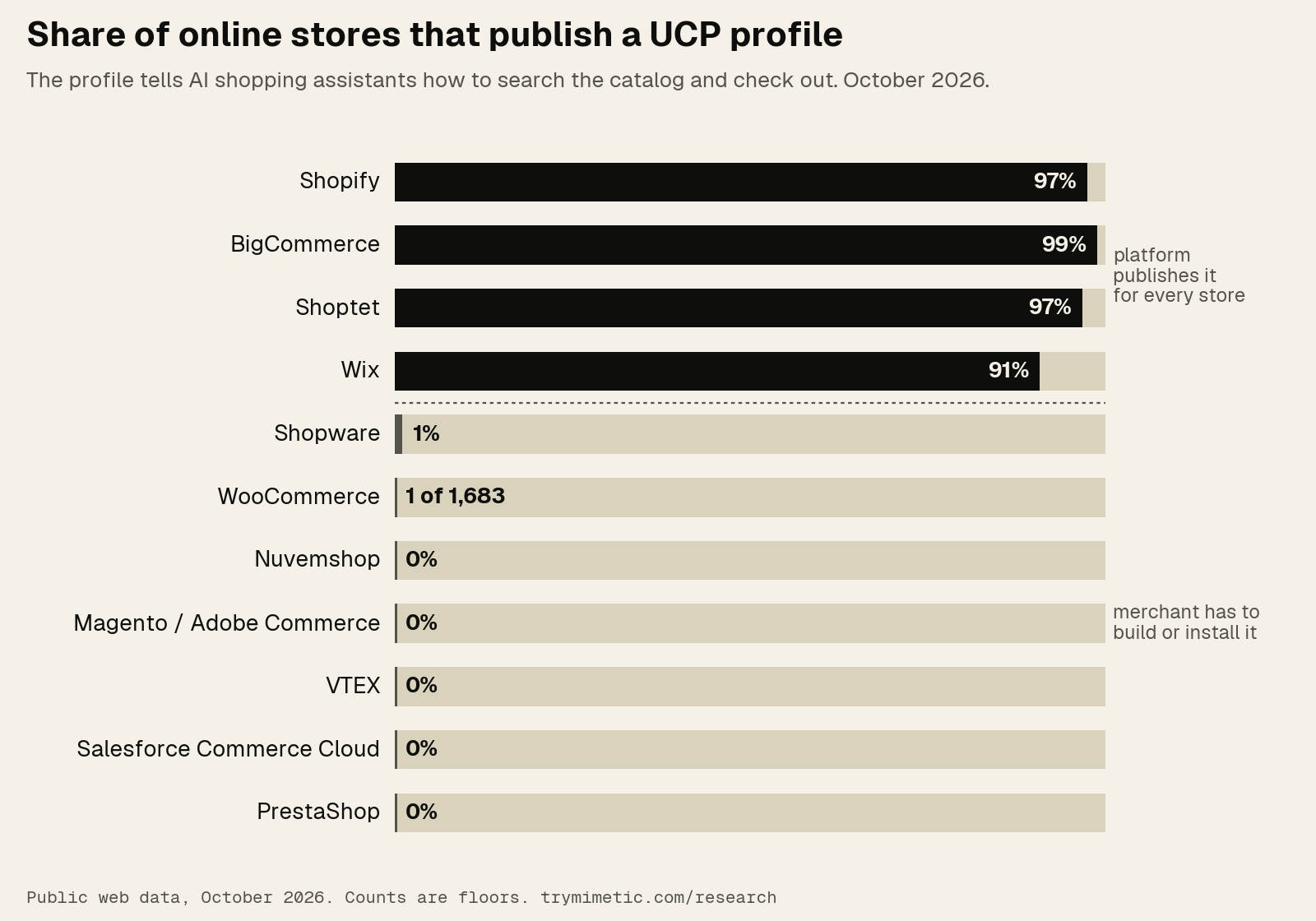
Five platforms publish a profile for every store, with no setup by the merchant: Shopify, BigCommerce, Wix, Shoptet and Jumpseller. On each of them, more than 9 in 10 stores have one. Salla, Zid, Simplia and a few smaller platforms do the same.
On the platforms where the merchant has to switch it on, install an extension or build it, almost nobody has:
- WooCommerce: 1 store of 1,683, using a plugin.
- Adobe Commerce / Magento: 0 of 1,653.
- Salesforce Commerce Cloud: 0 of 994. Salesforce added a "UCP Active" setting in release 26.9, for US English sites.
- Nuvemshop, VTEX, PrestaShop: 0 of 1,753, 1,002 and 506.
- Shopware: 2 of 186, both built by the merchant.
Site builders other than Wix, including Squarespace and Webflow, publish nothing. We found no profile on any of almost 40,000 sites built on them.
A profile is not the same as a sale
Having a profile makes a store findable. Being able to buy inside an assistant is a second step:
- On Shopify and Wix, an assistant can connect and search the catalog without a login. BigCommerce's endpoint asks for credentials, and Jumpseller's covers catalog and cart but not checkout.
- Several platforms publish profiles that don't pass the UCP schema, including Salla, Zid and Fynd, so an assistant may not be able to read them.
- Checkout inside Google's AI Mode and Gemini needs Google's approval on every platform. Only Shopify turns it on by default, for eligible US stores with a Merchant Center account. Everyone else applies.
The retailers that built their own
Only 45 companies across everything we checked built a profile themselves. 30 are retailers, among them Chewy, HP, Academy Sports + Outdoors, Scheels, Sweetwater, Birkenstock, Arc'teryx, Sézane, thredUP and Backcountry. Most are large retailers whose platforms don't publish a profile for them.
The door is open
Very few stores keep AI assistants out. Of 22,684 online stores, 1.3% block the crawlers that ChatGPT, Claude and Perplexity use to answer shoppers' questions, or block all crawlers, and 3.2% block at least one AI training crawler. The gap is not permission. On most platforms, it is that the store has nothing for an assistant to connect to.
What this means for a store
- On Shopify, BigCommerce or Wix: the profile is already there. The work is in what an assistant finds when it reads the catalog: product titles, descriptions, prices and availability it can trust.
- On WooCommerce, Adobe Commerce, Salesforce Commerce Cloud or a custom build: nothing happens until someone installs, switches on or builds it. Being early is still easy, since almost nobody else on those platforms has.
How to read the numbers
- Public web data, October 2026. A store counts as ready if it publishes a UCP profile on its own domain.
- Every count is a floor. Some stores could not be checked, and a store can support UCP in ways we did not see.
Want to know how an AI assistant sees your store? Start at trymimetic.com.