Most llms.txt files on online stores were written by the platform
llms.txt is a plain text file at the root of a website that summarizes the site for AI models: what it is, and which pages matter. It was proposed in 2024, and it has spread fast, mostly because platforms started creating it for their customers.
We checked 22,684 online stores between September and November 2026. 63% serve an llms.txt file. But 51% of all stores have the one their platform created automatically, and only 12% published one of their own.
Shopify and Wix write it for you
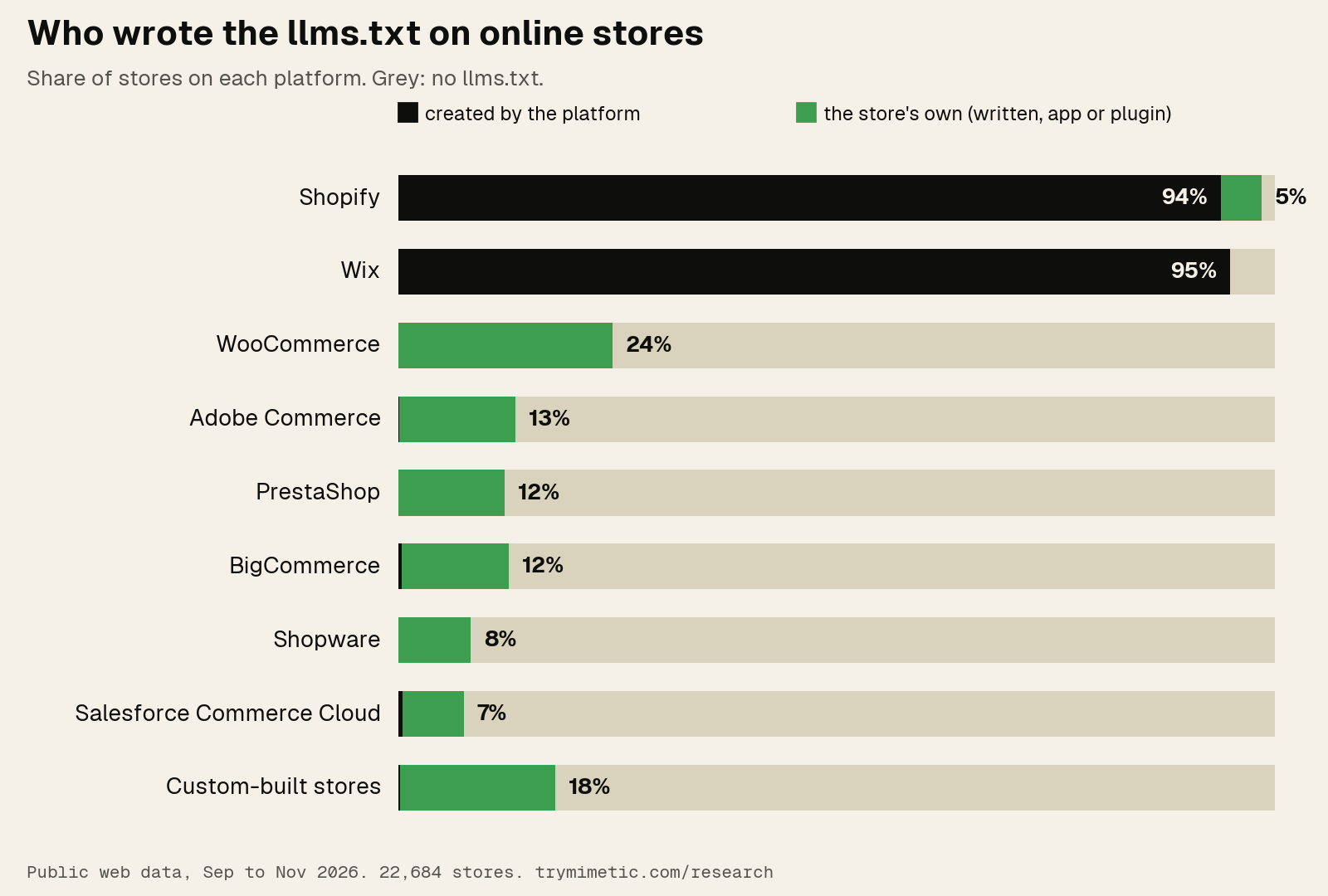
- Shopify serves an llms.txt on every store it hosts, the same file with the store's name swapped in. 94% of Shopify stores have that default. 5% replaced it with their own.
- Wix generates one for Premium eCommerce sites, and 95% of Wix stores have it.
- Nuvemshop stores carry a generated file too.
On a store from one of these platforms, an llms.txt says nothing about whether the brand has thought about AI search. It says which platform the store is on.
Elsewhere, about one store in eight has one
On platforms that don't create the file, the store has to add it, through an app, an SEO plugin or by hand:
- WooCommerce: 24%. Two thirds of these were generated by an SEO plugin such as Yoast or All in One SEO.
- Custom-built stores: 18%.
- Adobe Commerce: 13%. PrestaShop and BigCommerce: 12%.
- Shopware: 8%. Salesforce Commerce Cloud: 7%.
Across every platform except Shopify and Wix, 20% of stores published their own.
Does it matter?
Nobody knows yet, and it's worth being honest about that. Google has said its search doesn't use llms.txt, including for AI Overviews and AI Mode. Other AI companies haven't said either way. The file is cheap to publish, which is why platforms do it by default, but there is no public evidence that having one changes how often a store is recommended.
What does matter for AI search is the same thing that matters for people: clear product pages, prices and availability an assistant can read, and a catalog it can search. On most platforms, that is a bigger gap than the text file.
How to read the numbers
- Public web data, September to November 2026. 22,684 online stores.
- "Created by the platform" means the file matches the platform's default. "The store's own" includes files written by hand, by an app or by an SEO plugin.
- Every count is a floor. A store that blocked our request is counted as having no file.
See how AI assistants read your store at trymimetic.com.